
Passionflower, aka Maypop, or Passiflora incarnata, is a relatively common plant that grows wild in sunny fields and unkempt yards in the southern United States and up the Eastern Coast and surrounding states. If it doesn’t grow wild around you, there is a possibility that you can find a potted plant at a specialty nursery.
Passionflower can be considered invasive, but with such amazing benefits, who really cares?
Passionflower is native to the Southern United States, from Texas to Tennessee, and Virginia, all the way down to Central and South America. Europe, especially Italy, cultivates it extensively for commercial use.
The first recorded use dates back to the time of the Aztecs!
The flowers, ripe fruit and juice, and leaves are used medicinally and for food. Flowers and leaves can be used raw, steeped in tea, or tinctured, and fruit can be enjoyed as a fresh snack or used for preserves if found in abundance. Passion fruit can be found late in the summer through fall until the first frost. Leaves are three-lobed and can be 5″ or more wide, and the vine can grow up to 28 feet long!
There are about 400 Passiflora species, and they mostly work the same way. P. quadrangularis has also been found to contain serotonin, one of the main chemical messengers in the brain, which is considered one of the ‘happy’ chemicals along with dopamine that is depleted by continuous drug use, mainly associated with uppers, like cocaine and Meth.
Passionflower is high in Vitamin A and Niacin.
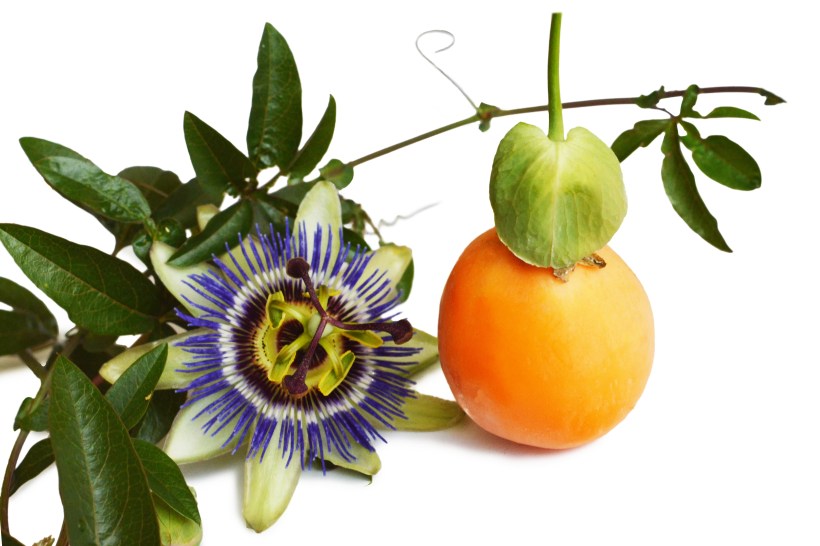
Vines produce a lot of fruit the year after a drought, but be careful not to over-harvest. Passionflower will self-sow and come back year after year if allowed to.
Fruit is about 2″ and green when unripe. Fruit is ripe when it turns from “Kermit the Frog” green to light green to yellow-orange in color. They look like little melons growing in the wild to me. Or even like large cucamelons (Mexican Sour Gherkins) before they ripen. The first time I stumbled upon them in the wild, I did not know what they were, and I asked, “What are these little mini-melon-looking things?” Nobody around me knew, so I made it a point to figure it out. The skin of ripe fruit will be slightly wrinkled. The unripe fruit has very firm skin. Eat it much like a pomegranate because of the many seeds–which are roasted and eaten in Puerto Rico as a delicacy. The white pulp inside the skin can be scooped out and eaten. Passionflower can quickly cover large areas once established, so picking leaves and stems for use can keep the plant from spreading excessively. Picking flowers lessens the amount of fruit you will get, as, like many plants, the fruit forms from the flower.
Passionflower can be propagated by seed in spring after cold stratification and needs plenty of sunlight. Aerial parts are gathered when the plant is flowering or in fruit.
Cold stratification is when a seed is exposed to a cold and moist environment for a period of time. In the wild, seeds undergo cold stratification during the winter after they have fallen to the ground from a mature plant, but you can also achieve the same thing by placing seeds in a ziploc bag with a moist piece of paper towel and placing them in the fridge for a few weeks. Different seeds need different ‘cold strat’ times.
Some seeds, like Passionflower, may need to be stratified for a month or more before they will germinate. Keep an eye on your paper towel and change it out every few days to avoid mold. Once your seeds mold, they are no longer viable.
Passionflower has been used as a sedative and tranquilizer in Central and North American herbal traditions for centuries and taken in Mexico for insomnia, epilepsy, and hysteria. The Algonquin people of North America used it as a tranquilizer.
The flowers can also be used for tea, but they lack the sedative effect, and you also lose the potential fruit that would form from that flower once you pick it.
This lady is widely acknowledged as a good treatment for anxiety, tension, irritability, and insomnia. Gentle sedative properties produce a relaxing effect and reduce nervous activity and panic. It is a mild and nonaddictive herbal tranquilizer comparable in some ways to Valerian (Valeriana officinalis). Along with sedative properties, it also has valuable painkilling properties that are good for toothache, menstrual pain, and headaches and is known for helping with sleeplessness associated with back pain.
Passionflower has also been used to treat conditions such as asthma, palpitations, high blood pressure, and muscle cramps. All-in-all, this is a great plant to have around, whether used for occasional sleeplessness or lingering anxiety and headaches. Its ability to help with all of these ailments lies in its relaxing properties.
Dried leaves and stems contain alkaloids with a sedative effect and are sold over the counter in the United States as “sleepy time” tea, like Dormialfin.
Leaves are mainly used as a sedative, while flowers are used for calming anxiety.
Passionflower Contains:
- Flavanoids (apigenin)
- Maltol
- Cyanogenic glycosides (gynocardin)
- Indole alkaloids (harman)
Subscribe to get full access to this post.
Read more of this post when you subscribe today.
If you enjoyed today’s content, like, subscribe, and do all the things to stay up-to-date. All of my links are at the bottom of the page, but Facebook is the most updated social spot to follow.
Many blessings,
Emma Lee Joy


 Red Hawk Ridge
Leave a reply to Rosemary – Red Hawk Ridge Cancel reply