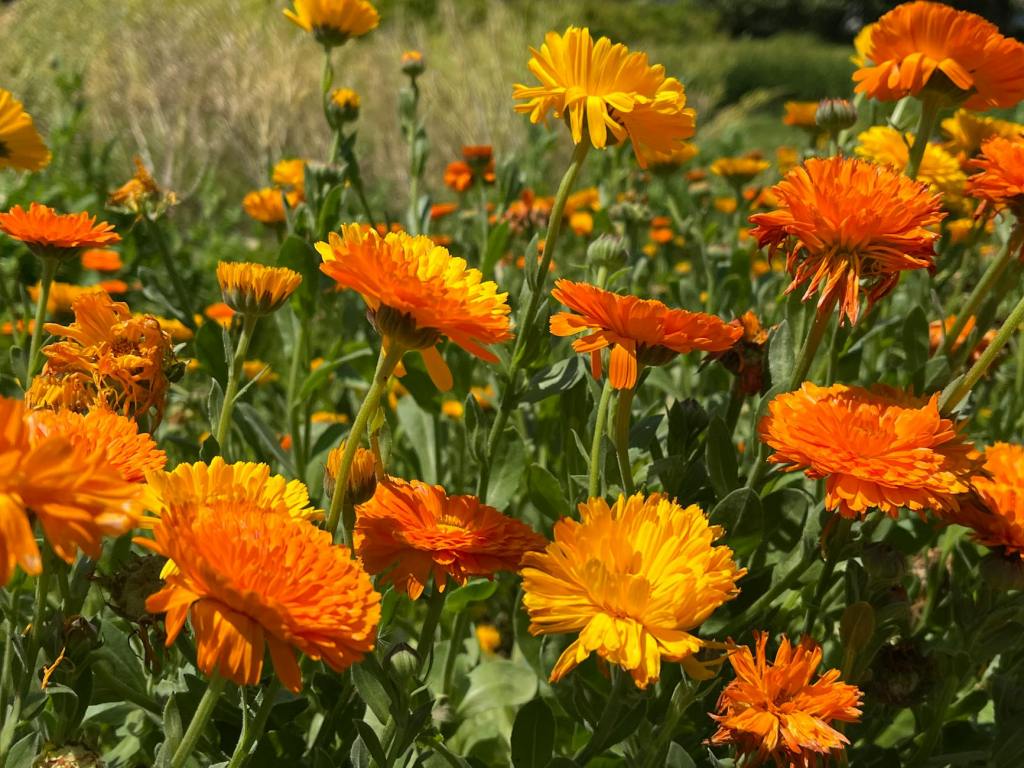
Calendula, Calendula officinalis, also known as Pot Marigold, Common Marigold, or Scotch Marigold is not a true Marigold (Tagetes spp.). They are both members of the sunflower (Asteraceae) family, but of different genus. Calendula is an annual that can grow to 2 feet tall and has vivid orange flower heads that have a similar structure to daisies, while Marigold can grow anywhere from 1-4 feet tall. Calendula petals are long and straight, while Marigold petals tend to be more rectangular with rounded edges. The seeds also look wildly different. Calendula seeds are curled, while Marigold seeds look more like sunflower seeds.
All parts of Calendula are safe to use, but only certain varieties of Marigold could be deemed edible. Best to stay away from the latter all together when working with food or medicine.
Calendula is one of the hardiest flowers in the garden. She can bloom early and survive the first snowfall of winter, leaving her as one of the last annuals in your garden! You can sow seeds directly into the garden in spring or in more temperate areas with milder winters, you can sow seeds in the fall or early spring. Mature plants can also be left to go to seed and can self-sow themselves in the right climates.
A great thing about Calendula is that the more flowers you pick, the more the plant puts out, which is great once you learn everything this lovely lady can do! Native to southern Europe, but cultivated in temperate regions around the world, Calendula is easily propagated from seed. Just make sure you read seed packages and know the scientific name so you don’t end up with Marigolds. Calendula isn’t fussy, but prefers full sunshine, good fertile soil, and occasional watering. She can survive in poor soil and a little neglect; however, she will do her best when tended regularly, as most plants do. Flowers are harvested as they open and dried in the shade.
Calendula arvense is a wild species of Calendula with similar properties to C. officinalis cultivated in gardens.
Calendula is a very versatile herb in Western Herbalism and can be used for:
- red/inflamed skin
- prevent spread of infection
- speed up wound healing
- cleanse
- detox
- treat chronic infections
Key Actions include:
- anti-inflammatory
- relieves muscle spasms
- astringent
- prevents hemorrhaging
- heals wounds
- antiseptic
- detoxifying
- mildly estrogenic (regulates hormones)
Calendula is mainly a skin remedy and can help with most skin ailments, including but not limited to cuts, scrapes, wounds, inflammation like burns and sunburn, acne, rashes, fungal conditions, diaper rash, cradle cap, and soothing nipples while breastfeeding. Preparations for these ailments are generally external but taking them internally is a great way to help with fungal conditions and stomach issues like ulcers.
Calendula can be enjoyed as a tea for funsies.
Calendula Tea
To make an everyday, enjoyable tea, place 1-2 teaspoons of tea directly into a cup or use a tea bag/ball and pour 1 cup of almost boiling water over it. Let it steep for 4-5 minutes, or to taste. Strain, sweeten if desired, and enjoy! Calendula has a slightly bitter taste that some people may not like, but honey fixes everything.
Calendula Infusion
NOTE: An infusion is a strong tea suitable for the aerial parts of plants like leaves and flowers. It can be enjoyable, depending on the herbs used, and some people prefer stronger infusions to plain tea. The steep time and amount of herbs are what make the difference. This is a medicinal preparation, and as medicine goes, it isn’t always the most enjoyable, but it can be.
Bring 1 cup water almost to boiling and pour over 1-2 tablespoons of flowers, either loose or in a tea bag/ball. Let steep anywhere from half an hour to overnight and strain. If taking internally, sweeten with honey to make it more palatable.
This infusion, once cooled to a temperature that won’t scald the skin, can be poured directly over affected areas, or you can soak a poultice wrap or cloth and place over the area. You can also pour it directly into a bath, although I would double the batch or strength for a bath.
Calendula Salve
NOTE: Calendula Salve is the easiest way to make a topical skin remedy as creams are a little more complicated to make. Check out the subscriber section for recipes if you are interested.
Start with infusing an oil with Calendula flowers.
Olive and Avocado Oil are my favorites. You can use either the slow (takes about 4 weeks) or quick method (takes about 30-60 minutes) mentioned in my Herbal Infused Oils post, but the best method is the slow method. If you use too much heat while infusing oil, you can end up cooking the flowers and rendering any benefits from them void. That said, you also need to be careful if using fresh flowers to slowly infuse oil. Moisture in oil can cause mold, so if you use fresh flowers, I recommend using a rubber band and muslin, cheesecloth, or a coffee filter as a lid instead of an airtight lid so moisture can escape. Make sure flowers stay submerged. I use a chopstick to poke them and stir every other day or so when using fresh herbs to infuse oil.
Once oil is ready, strain it and store in a clean jar if you don’t use all of it for this recipe. Don’t forget to label your jars!
Place 1 cup infused oil in a double boiler with 1/4 cup of beeswax. Slowly heat until the beeswax melts and then keep the heat on it for another 10-15 minutes to make sure the beeswax is well incorporated with the infused oil. Take off the heat, and if you want, now is when you should add any essential oils (10-20 drops). Stir well.
Clean/sterilize your jar(s).
Pour in your salve, cap, and don’t forget to label! Try not to move it until it sets up, which takes about half an hour to an hour, depending on the temperature of where you are.
TIP: If you are in a hot climate or season, you can make a balm that has a higher melting point. Add 1/2 cup of beeswax to 1 cup of infused oil and make the same way. It will come out harder and will stand up better to higher temperatures. Stick with a salve if you are in colder climates or in the middle of winter. Balms can get pretty hard if you don’t add other fats like tallow and shea butter. I have recipes that include fats in the subscriber section of the Herbal Balms and Salves post.
OTHER POSSIBLE USES:
- Apply salve or tincture directly to bunions 2-3 times a day for a week.
- Use infusion as a mouthwash for gingivitis.
- Rub a fresh Calendula flower on insect bites and stings for pain and swelling.
- Use salve in place of Neosporin to prevent infection in minor cuts and scrapes.
- Can help prevent staphylococcus infection.
- Apply Calendula cream to sunburns to speed healing and nourish the skin.
- Drink Calendula infusion to help alleviate symptoms of chronic stomach inflammation and heal ulcers.
Subscribe to get access
Read more of this content when you subscribe today.
You can find “Calendula Tea,” which can be used to make teas, infusions, tinctures, and more, in my shop. While you are there, check out the other products I have. I’m sure you will find something you like! Orders over $35 get free shipping. If you like the content I create, follow this blog, my Facebook page, or my Instagram!
Many blessings,
Emma Lee Joy
Information in this article was derived from personal knowledge and experience, as well as the following texts:
* “Encyclopedia of Herbal Medicine, 2nd Edition” by Andrew Chevalier FNIMH, pg. 73
* “Medicinal Herbs: A Beginner’s Guide” by Rosemary Gladstar, pg. 112-113
* “The Green Pharmacy” by James A. Duke Ph.D., pg. 100, 217, 293, 417, & 439

 Red Hawk Ridge
Leave a comment