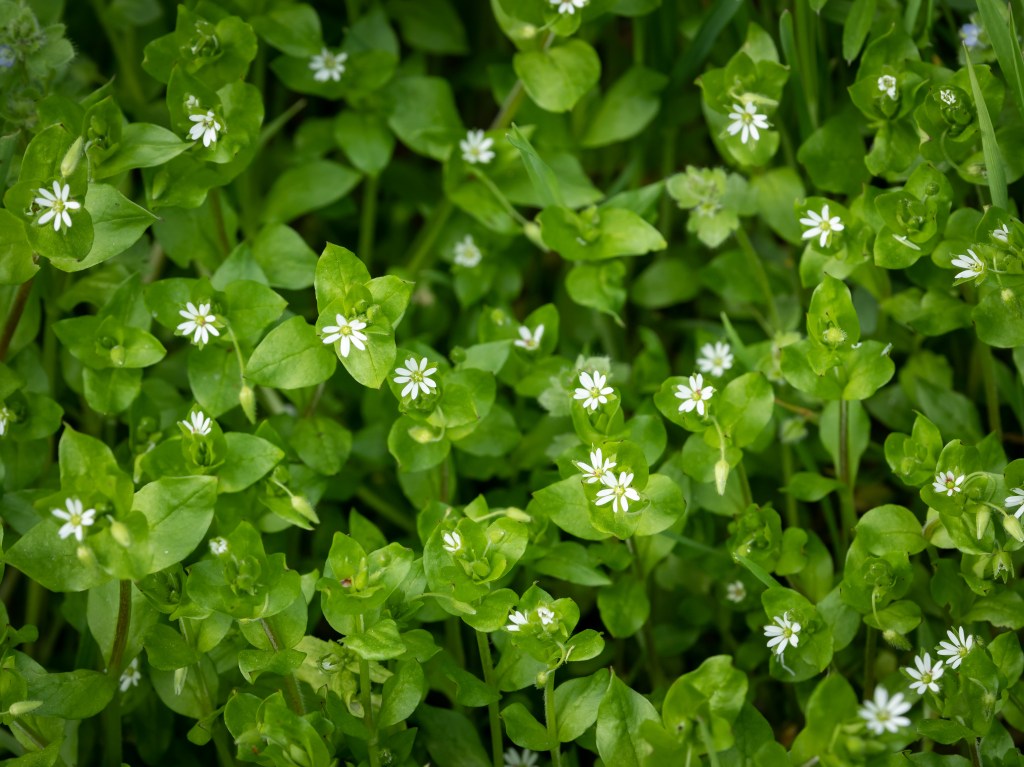
As spring officially starts this week, I found it fitting for the Herb of the Week to be Chickweed. Chickweed symbolizes a fresh start and demonstrates the ability to flourish in the humblest situations. This lady is an often-overlooked treasure that beckons us to notice the smallest things that can have the greatest impact.
Chickweed, Stellaria media, aka chick whittles, clucken wort, adder’s mouth, white bird’s eyes, satin flower, winter weed, and chicken weed, is available for harvest almost year-round in many climates. It should be noted that the plant becomes fibrous and tough in midsummer (when it isn’t advisable to harvest, especially to eat) and disappears for a short time in mid-winter.
The name Stellaria comes from the fact that the flowers are like little stars.
Stellaria= “star”
media= “in the midst of”
This little beauty is native to Europe but thrives in 53-68 degrees Fahrenheit weather, in either full or partial sun, with moist soil. Usually found in the fall and spring and is considered a ‘cool weather’ plant. Chickweed is considered invasive, so there are usually no limitations to how much you can pick.
Avoid harvesting plants growing near busy roadways and polluted areas.
Chickweed has shallow roots, making it a great ground cover in the garden to suppress weeds, and acts as a living mulch to keep the soil healthy. It makes the perfect ground cover for a salad garden since the leaves make a great healthy addition to food, raw or cooked.
Although beloved by chickens, Chickweed is an excellent salad plant for humans, especially in late winter and early spring. It has an earthy, slightly salty tang and is easily gathered. Unlike dandelions and mustard, it is not very bitter. All parts are edible and high in vitamins like A and C, saponins, and minerals, including iron, copper, magnesium, and calcium, making it one of the best spring tonic herbs. The above-ground parts are the most commonly used. Chickweed is tender and juicy and is called the tenderest of wild greens, at least before midsummer.
FUN FACT: Chickweed has a folk reputation as a weight-loss herb. It can be eaten raw in salads, steamed, or sautéed. Matched with other weeds known to be slimming, like dandelion, evening primrose, stinging nettle (cooked and cooled to take the sting out), plantain, and purslane, you can make a nice wildcrafted salad to add to a weight-loss regime.
Chickweed Contains:
- Triterpenoid saponins
- Coumarins
- Flavonoids
- Carboxylic acids
- Vitamin C and others
“The saponins may account for the herb’s ability to reduce itchiness.”
-Encyclopedia of Herbal Medicine, 2nd American Edition, p. 272
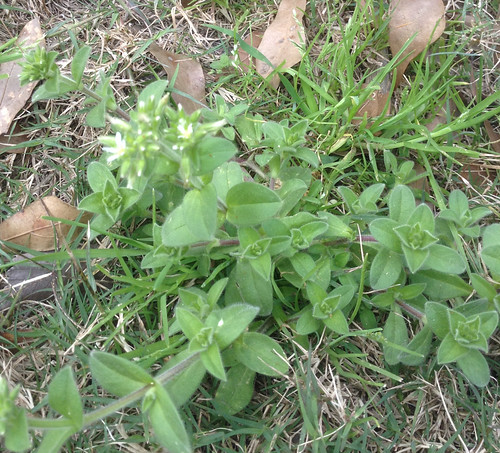
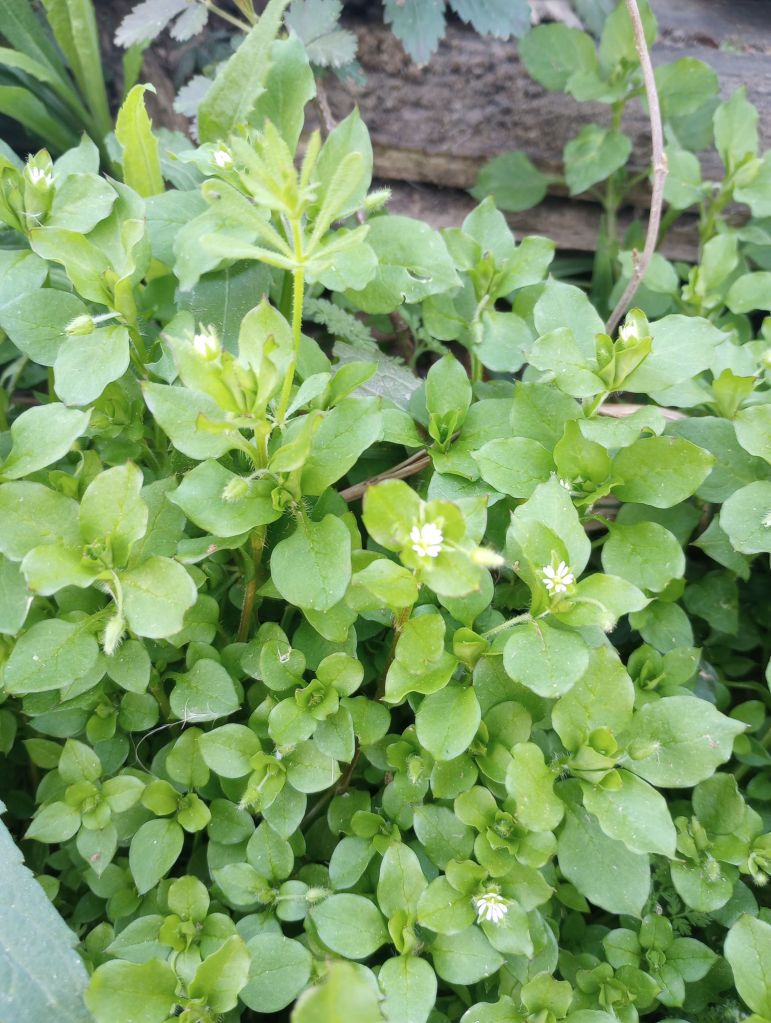
Chickweed is a floppy plant with smooth, light green leaves with a line of white hairs up the side of the round stem, and like its many cousins is found virtually everywhere in the world. It prefers gardens, hedge banks, and waste grounds. The above-ground parts are gathered whenever vibrant and green.
“Think of chickweed as being as soft as slippery elm, as soothing as marshmallow, and as protective and strengthening as comfrey root.”
-Weed (1989)
Chickweed’s best-known external medicinal uses are to soothe itches, bites, stings, inflammation, burns, swelling, sunburn, bruises, splinters, and sore eyes. She makes a good and readily found first-aid/emergency remedy as well. Chickweed is great for resolving skin problems where some form of heat is involved and where other herbs or creams have failed, especially when a cooling, drawing action is needed.
Chickweed has the potential to soothe itchiness where other remedies have failed!
Chickweed Poultice
This is a super easy remedy that can be made on the fly in the field. If you don’t have a mortar and pestle or something else like a rock and a hard place, you can easily chew Chickweed to make a paste for a poultice. If you are home, you can throw a handful of Chickweed into a blender with a small amount of water (1-2 tablespoons p/cup of Chickweed). Blend into a mash and either fold into a clean cloth or gauze or apply directly to the skin. Leave this on for around 30 minutes and change out as needed until the ailment clears up. This is good for itchy and irritated skin, whether from bug bites or hot, inflamed rashes (like from Stinging Nettles).
Chickweed is gentle enough to use for soothing itchy and irritated eyes. Place a poultice on closed eyes to cool and soothe.
Known for clearing up long-standing or ‘indolent’ (slow to develop, progress, or heal; persistent) damage, such as eczema, rheumatic joints, and varicose veins, and is also safe for delicate organs that need cooling and soothing, making it great for eye inflammations of most sorts, including itchiness from contact lenses. This lady is known for many similar healing properties that Slippery Elm Bark has.
“Chickweed can also be frozen and used topically for itchy and weeping skin conditions.“
-Encyclopedia of Herbal Medicine, 2nd Edition, pg. 289
Chickweed internally helps with hot inflammatory problems like gastritis, colitis, congested chest, blocked kidneys, and gallbladder. It is great for the lungs, sore throats, bronchitis, asthma, irritable/dry cough, and other respiratory problems.
Chickweed Tea
Bring 1 cup of water to almost boiling and pour over 1-2 tablespoons of fresh chickweed. Steep for 10 minutes, or to taste. Strain and sweeten with local honey (optional). Lemon is a great addition to this tea if you like that kind of thing.
Chickweed contains saponins, which means ‘soap-like.’ If you take and rub it in your hands with a little water, you may not actually get bubbles, but you will feel the soapiness, leaving your hands feeling lovely and soft, if smelling like chickweed. Because of the saponin content, consuming large amounts may cause digestive upset. Start with a few bites and work your way up to 1 to 2 cups a day to avoid any issues if you want to eat chickweed regularly.
Chopped small, chickweed can give soups and stews a creamy texture!
“This small herb, often classed as a troublesome weed, is one of the supreme healers of the herbal kingdom and has given me wonderful results.“
-Levi (1966)
Chickweed isn’t known for drying or keeping well, so if you want to preserve it, make a tincture, juice and freeze, or make infused oil to turn into soothing skin salve.
WARNINGS:
Excessive intake of saponins should be avoided during pregnancy or while breastfeeding.
Excess intake of Chickweed can cause diarrhea and vomiting.
Subscribe to get full blog access
Chickweed is deeply healing. It can reach the places you don’t think about and is gentle enough for kids to use. Walk around in the wild and see if you can’t spot this lovely lady waiting for you. Where she is found, she is usually found in abundance!
Chickweed only has one poisonous “look-alike,” Scarlet Pimpernel, but is told apart by the square stems and reddish-orange flowers. Chickweed has round stems with white flowers. I don’t personally consider it a look-alike, but if you ask the internet, that’s what it gives you. Do your research, use common sense, and you will be fine.
If you liked this post, follow this blog to get updated when I post. You can also find me on Facebook and Instagram! I have a shop where you can find herbal remedies like tinctures, salves, teas, supplements, and more. Orders over $35 get free shipping.
Many blessings,
Emma Lee Joy
Information in this article was derived from personal knowledge and experience, as well as the following sources:
* “Encyclopedia of Herbal Medicine, 2nd Edition” by Andrew Chevalier FNIMH, pg. 272, 289
* “Backyard Medicine, 2nd Edition” by Julie Bruton-Seal & Matthew Seal, pg. 42-45
* “Medicinal Herbs: A Beginner’s Guide” by Rosemary Gladstar, pg. 121-123
* “The Green Pharmacy” by James A. Duke Ph.D., pg. 346
* “The Illustrated Herbiary” by Maia Toll, pg. 17-19
* “Chickweed” from Foraging Texas

 Red Hawk Ridge
Leave a comment