
Cleavers, Galium aparine, aka Sticky Weed, Goose Grass, and Sticky-Willy, is a sprawling, square-stemmed annual most people consider a nuisance. It can grow up to 4 feet (or more) long and has whorls of lance-shaped leaves every few inches along the stem with small, white, star-like flowers. The fruit is green and prickly, sticking to anything it touches. The whole plant has a tendency to stick to anything it can make purchase with once closer to maturity, hence the nickname Sticky Weed. I have even heard it called Velcro Weed, but that isn’t a name you see much.
Native throughout Europe and North America, Cleavers can be found in many temperate climates and are generally the first spring tonic herbs to sprout. You can find it growing freely in gardens, on roadsides, and basically, anywhere the seeds have managed to plant themselves as early as December in sheltered areas. This lady is relatively hardy and, here in East Texas, will grow almost year-round. I typically find baby cleavers around the chicken coop in December to January, but severe weather that comes with the occasional cold winters here in January and February may kill them. But that won’t stop them from coming back in March. Cleavers sprout before and alongside Violets, Chickweed, and Dandelions in late Winter and early Spring in many places.
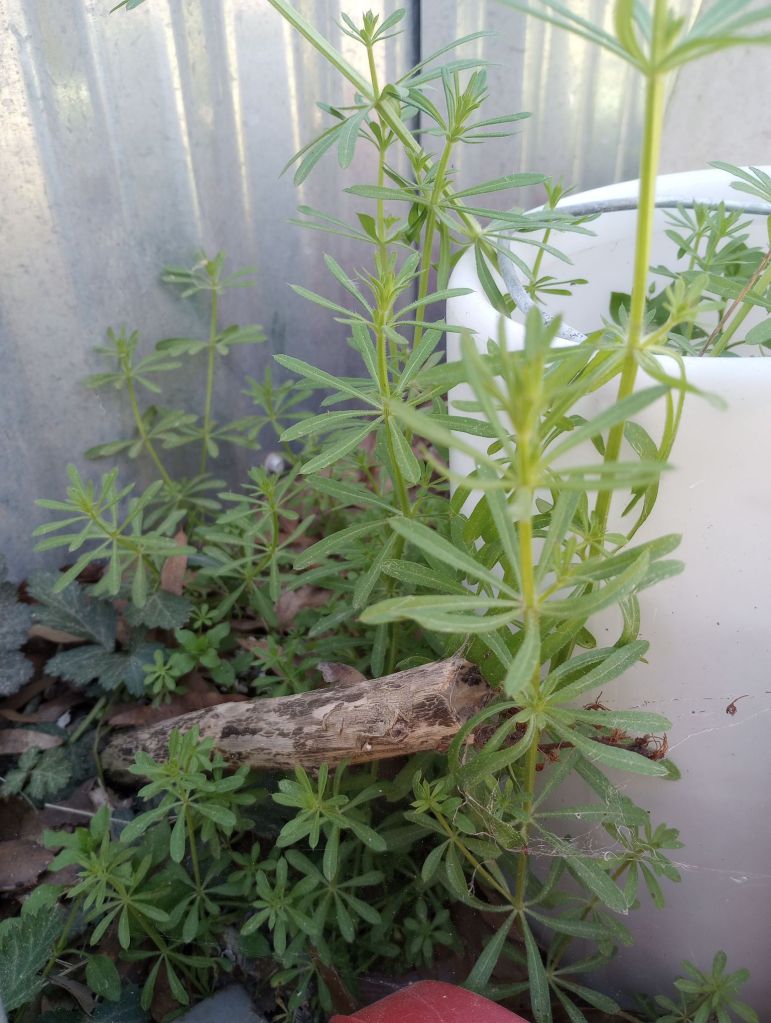
Harvest aerial parts for medicinal use before she flowers in mid-to-late Spring. The best time for salad greens is in February when they are still young and tender.
Cleavers Contain:
- iridoids (including asperuloside, which is a mild laxative)
- polyphenolic acids
- anthraquinones (only in the root)
- alkanes
- flavonoids
- tannins
Key Actions & Uses:
- diuretic (the juice is a very strong diuretic)
- swollen lymph glands
- detoxifying
- kidney stones
- urinary problems
“Dioscorides, a Greek physician of the 1st century AD, considered it useful for countering weariness, and described how shepherds used the stems to make sieves for straining milk.”
-Encyclopedia of Herbal Medicine, 2nd Edition, pg. 214
Internally, Cleavers can help treat skin issues like seborrhea, eczema, psoriasis, and swollen lymph glands and help detoxify the body. As an early sprouting plant, Cleavers are great for a Spring detox. Juiced like a vegetable (which renders it a heavy diuretic), Cleavers can rid the body of Kidney stones and heal a variety of urinary tract issues. Cleaver extract may also lower blood pressure!
Cleavers are most known for their use in lymphatic system health. The lymphatic system is comprised of organs, vessels, and tissues that work in maintaining fluid balance and protecting the body against infection. Cleavers clean and detox this system so it can work at optimal levels. The actions it takes in the body for this process make it an excellent remedy for swollen glands, tonsillitis, adenoid problems, and even earaches.
Cleavers also are known to help shrink tumors and remove nodular growths in the skin because of the lymphatic support it gives the body. Cleavers have also been used as a drink and gargle to treat cancers of the throat and mouth.
Sun-Infused Cleaver Tea
Cleaver tea can be made like a regular infusion with hot water, but here is another way to do it that might taste better!
Collect your cleavers, wash, chop, and place them in a jar. Pour cold or room temperature water over them and let the infusion sit for a few hours in the sun on a windowsill. You don’t have to strain the infusion; just pour off a cup and drink daily in Spring and early Summer to keep your lymphatic system clear. You can top the jar off with water each day for a few days before you will need to replace it with fresh Cleavers. After the first day, you can store in the fridge or a cool area to prolong the life of your tea.
Cleavers have a fresh mowed grass smell and may not be the best-tasting tea for some people, but that doesn’t make it any less beneficial.
Cold Infusion can help with:
- swollen glands
- painful breasts
- fluid retention
- tonsillitis
- breast cysts
- bladder irritation
- burning urine
Other species have also been used medicinally historically. The Mexican G. orizabense rids the body of parasites and relieves fevers, while the New Zealand variety G. umbrosum, can treat gonorrhea. Lady’s Bedstraw, G. verum, and hedge bedstraw, G. mollugo, can be used medicinally just like Cleavers.
Cleavers is yet another plant people consider a weed that is highly beneficial, especially as we awaken from the stagnation of Winter. This lady loses some of her efficacy when dried and is best used in fresh, like Chickweed. You can freeze the juice for use later in the year once local plants have gone beyond their prime.
Cleavers Poultice
A cleavers poultice is used in the same way as a Chickweed poultice for nettle rash, burns, blisters, and other hot inflammation of the skin. Blend a handful of Cleavers in a blender with a small amount of water (1-2 tablespoons p/cup of Cleavers) or mash in a mortar and pestle. Either fold into a clean cloth or gauze or apply directly to the skin. Leave this on for around 30 minutes and change out as needed until the ailment clears up.
“It is a good remedy in the Spring, eaten (being first chopped small, and boiled well) in water-gruel, to cleanse the blood, and strengthen the liver, thereby to keep the body in health, and fitting it for that change of season that is coming.”
-Nicholas Culpepper (1653)
Subscribe to get full access to blog posts.
Like and subscribe to this blog if you liked today’s content. You can also find me on Facebook and Instagram where I post updates or check out my shop. I have natural remedies like tinctures, supplements, teas, and more! Orders over $35 get free shipping.
Many blessings,
Emma Lee Joy
Information in this article was derived from personal knowledge and experience, as well as the following texts:
* “Encyclopedia of Herbal Medicine, 2nd Edition” by Andrew Chevalier FNIMH, pg. 213-214
* “Backyard Medicine, 2nd Edition” by Julie-Bruton-Seal & Matthew Seal, pg. 46-49

 Red Hawk Ridge
Leave a comment