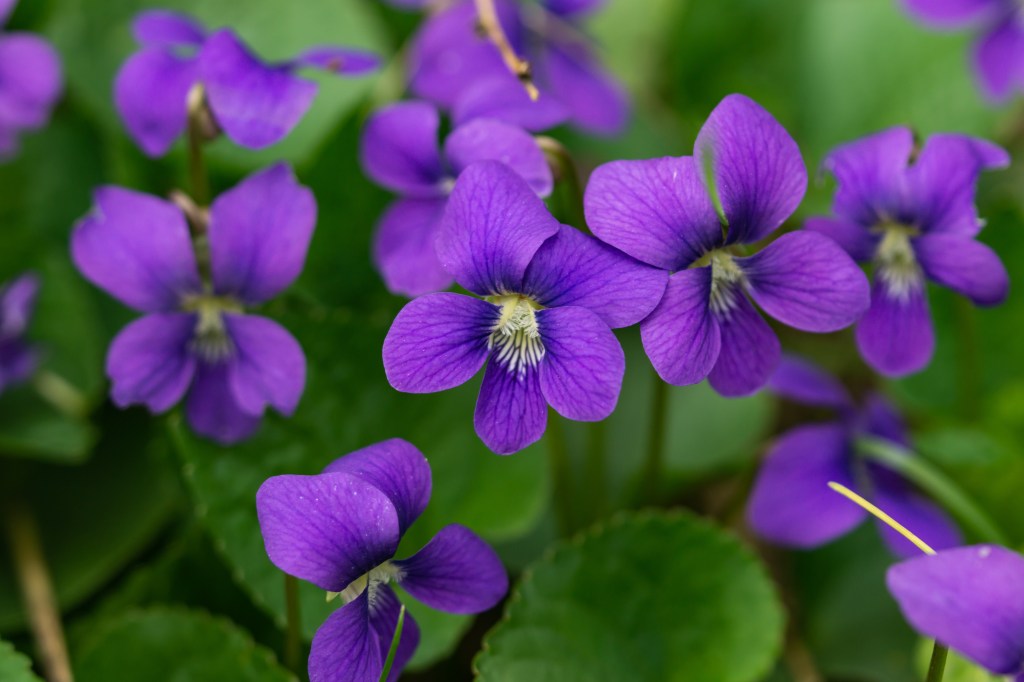
Sweet Violet, or Viola odorata, is the main violet used in herbalism, but the Common Blue Violet, Viola sororia, is, as the name states, common. It is what I personally have growing wild in my yard, so that’s what I use. Some other Violet species include Heartsease (V. tricolor), Common Dog Violet (V. rivinianna), and Early Wood Dog Violet (V. rivenbachiana). Today’s post will be specifically about Sweet Violet, with me sporadically mentioning my Blue Violets, but you can use what you have in the same way, except for Heartsease (it does other stuff). If you plan on eating the leaves, it is good to note that the taste can vary between species.
Sweet Violet is a creeping perennial that grows 6-10 inches tall and 12-18 inches across. With toothed, heart-shaped leaves and violet-blue 5-petaled flowers, it is relatively easy to identify. It likes partly shaded areas with moist, well-drained soil but can tolerate full sun in cool summer areas. Blooms in late winter or early spring. Here in Zone 8, they bloom mid-to-late January and early February, depending on the winter weather.
Note: Violet has a few look-alikes that are inedible or poisonous, so make sure you know what you are harvesting.
Violet is native to many parts of Europe and Asia but naturalized in other parts of the world, including the United States. She is easily found on roadsides and in wooded areas. The flowers and leaves are collected in the spring, while the roots are harvested in the fall.
My backyard is full of oak trees, and even through the dense layer of dead leaves, I can easily find dark green heart-shaped leaves of the Common Blue Violet peeking out along with purple-blue flowers. The foliage is evergreen, with slightly toothed, heart-shaped leaves that are a little fuzzy and grow in a basal rosette low to the ground. The flowers, with 5 petals, bloom on taller, leafless stems. Only one flower grows per stem, and the ‘seed pods’ that hang down look kind of like dark, mini bell peppers.
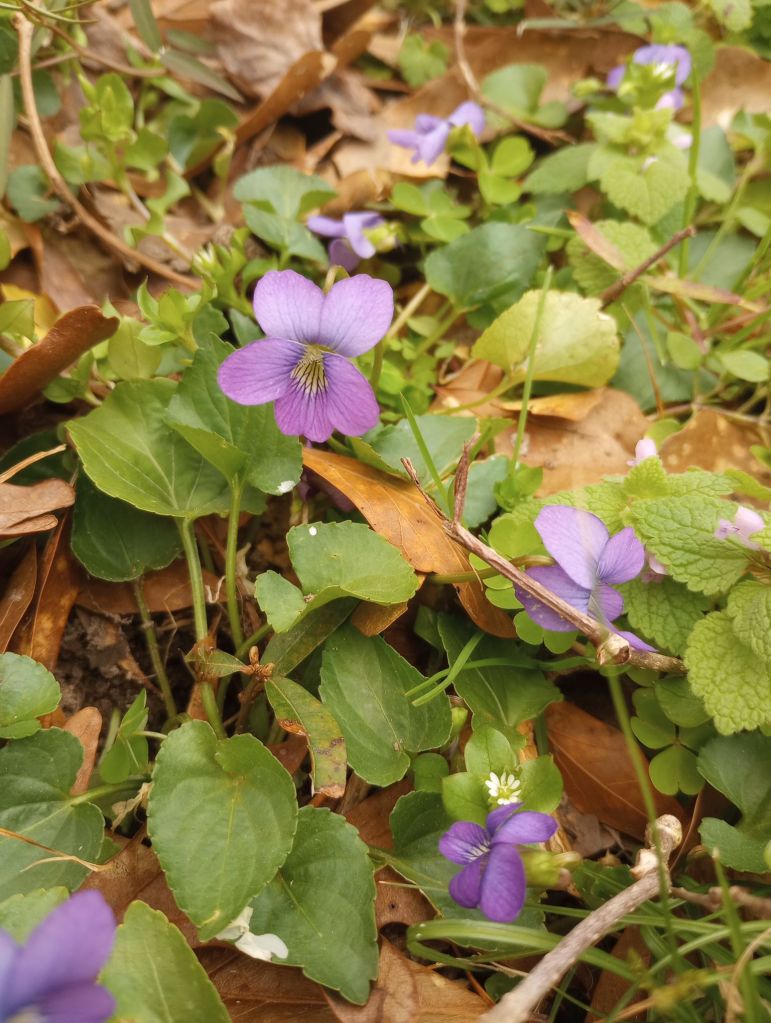
Propagated by seed or division, the plants are spread by runners and multiply at a decent rate once established. Cut runners and prune off spindly growth in the late fall for prettier/healthier plants come spring if you are cultivating them in your garden or flower beds. I haven’t had to do this. They are very intrusive where I live, and I frequently have to pull them out of my flower beds to make room for other stuff to grow. They freely grow in the yard, however, and are plentiful in areas where they are established.

Sweet Violet contains:
- phenolic glycosides (including gaultherin)
- saponins (myrosin and violin)
- flavonoids
- odoratine alkaloid
- mucilage (Like in Mallow, it is very useful for treating coughs and other respiratory issues.)
Leaves and flowers are a great source of Vitamins A and C.
Eat raw or mixed in a salad or green smoothie.
“Violine,” a compound found in Violets, is an ’emeto-cathartic’ in large doses, which means it can make you purge from both ends, but this is very rare. You would have to consume a very large amount of the leaves and flowers to bring about this side effect. However, unless you are experienced in the use of this plant and have some herbalism experience/knowledge, I would personally suggest that you don’t use the root, which is much more potent in its effects. The leaves and flowers are amazing and safe enough in times of need for inexperienced users.
The following bulleted info I found here. I am not affiliated in any way with the website, but it is a great read with more information not listed in this post.
• There are sweet and Dog Violets, the latter having no scent. Both types have heart-shaped leaves.
• Scented Violets are less commonly seen in the wild than the scentless varieties. Of the former, the whole plant is scented, not just the flower.
• Of the Dog Violets, the North American Violet, Viola cucullata, or Purple Violet, is bigger, later, and disappears completely in winter. Viola labradorica ‘Purpurea’ has purple leaves, complementing its paler petals. Both are ideal for wilder spaces as they can be invasive.
• Violets thrive in woodlands and on rough ground; they will grow in your garden if you give them the right conditions.
• Like wild strawberries, they make easy ground cover, spreading through runners, which easily take root. They make a very traditional (and charming) companion to roses.
• While people bemoan the diminishing prevalence of Violets in the wild (those who are not overrun with them at home), it is easy to create your own colony, making a deposit on the species’ future.


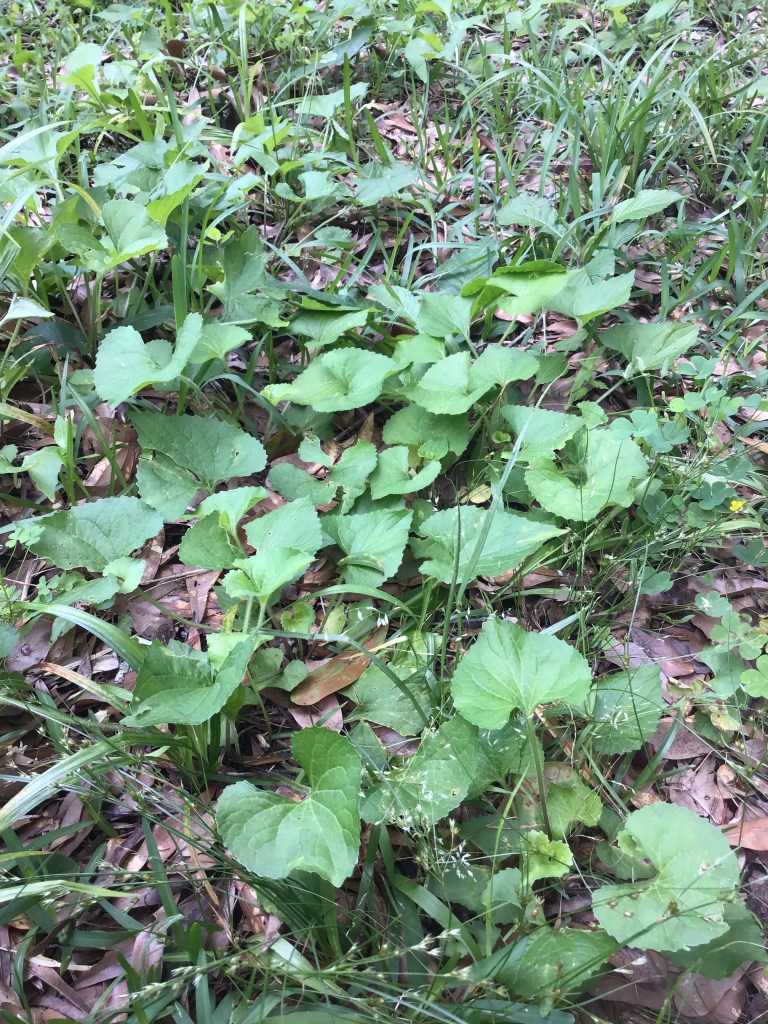
The two images below are Violet plants that have not flowered yet in my backyard. Even amongst the other flora, the heart-shaped leaves are very easy to distinguish once you know what you are looking at.

Although the plants are rabbit and deer resistant, they can suffer from slugs, snails, red spider mites, violet gall midge, pansy leaf spot, and powdery mildew. Many of these issues can be rampant in chronically moist or highly humid areas, especially mildew. Wild Violets don’t tend to suffer from these issues nearly as much as cultivated Violets, in my experience, even if in moist/humid areas. I’ve never had any issues with my wild-growing Violets, and they tend to be the prettiest plants growing in my yard, with very few blemishes.
Now for my favorite part: Flowers, leaves, and roots of Violet plants can all be used medicinally! Also, try the flowers fresh or candied for a treat. Violet flower syrup can even be used to spruce up pancakes…later mentioned, Buckwheat pancakes and Violet syrup are a great combo to help varicose veins.
“All the violets are cold and moist while they are fresh and green, and are used to cool any heat or distemperature of the body, either inwardly or outwardly.”
-Nicholas Culpepper, 17th Century Herbalist
Flowers and leaves have gentle expectorant (makes coughs productive) and demulcent (relieves inflammation or irritation) properties and induce light sweating. They are often made into infusions or syrup to treat coughs, chest colds, and congestion. The root is a much stronger expectorant and, at higher doses, is emetic (induces vomiting), so be warned. In British herbal medicine, Violet is used to treat breast and stomach cancer.
NOTE: You can find a recipe for Breast Oil in the subscriber section below.
“Varicose veins occur when the valves in the veins that prevent blood from flowing backward don’t work properly. Blood forms pools, and where this occurs, the veins and nearby capillaries become distended and swollen, leaking blood and fluid into surrounding tissue. This condition occurs most frequently in the legs; in areas where veins are near the surface, it causes unsightly bluish streaks, trails or spidery markings.”
-The Green Pharmacy by James A. Duke, Ph.D., page 445
“Violet flowers contain generous amounts of a compound called rutin, which helps maintain the strength and integrity of capillary walls. Medical texts say that taking 20 to 100 milligrams of rutin daily can significantly strengthen the capillaries.”
-The Green Pharmacy by James A. Duke, Ph.D., page 446
Subscribe for access to more content!
If you enjoyed today’s Herb of the Week, subscribe to this blog and I’ll see you back here next week! In the meantime, you can check out my Etsy shop where I sell natural remedies, read more about them on my Apothecary page, and find me on Facebook and Instagram!
Many blessings,
Emma Lee Joy
Information in this article was derived from personal knowledge and experience, as well as the following texts:
* “Encyclopedia of Herbal Medicine, 2nd Edition” by Andrew Chevalier FNIMH, pg. 282
* “The Green Pharmacy” by James A. Duke, Ph.D., pg. 446-447

 Red Hawk Ridge
Leave a comment