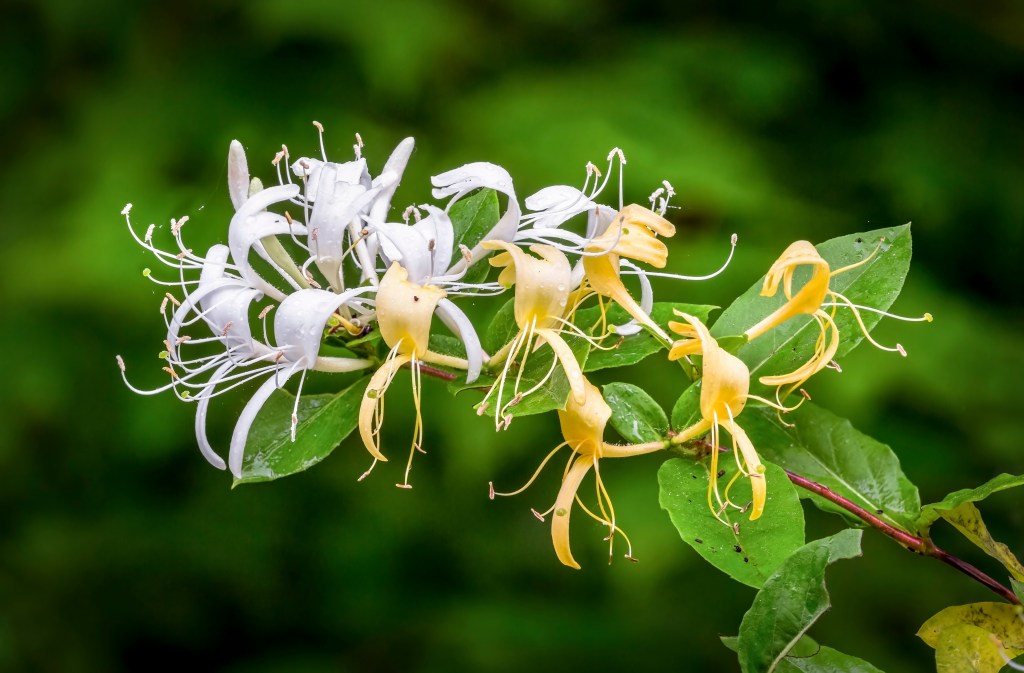
Honeysuckle, Lonicera spp., is a climbing bushy vine that can grow to 12 feet long, clinging to fences, trees, bushes, and anything else it can wind itself around. Species like L. japonica are semievergreen (lose most leaves at the same time each year, but not all), and others, like L. caprifolium, are deciduous (shed all leaves annually). It has paired oval leaves with yellow-orange or yellow-white tubular flowers and red or black berries, depending on the species.
Do not eat the berries. They are toxic to humans.
Some species are native to southern Europe and the Caucasus. It grows wild in many areas but thrives in warm areas with mild winters. I personally have L. japonica, which is native to China and Japan (also known as Jin yin hua). It is plentiful here in East Texas and will grow wherever it pleases. It is one plant I smell before I see it. In late spring and early summer, when the wind blows the right way, I can smell the sweet, honey-like scent in the air, and it never fails to make me giddy.
Honeysuckle is considered invasive and will choke out other plants.
Pick until your heart is content.
Honeysuckle is usually found climbing/growing over other plants, along fence rows, and even up walls if it can find something to cling to. The flower buds, open flowers, and leaves are generally gathered for medicinal purposes in the spring and summer before all flowers have fully opened. To make jelly and/or a flavorful tea or infusion, you want to pick the flowers that are yellow and fully open for maximum flavor and sweetness.
Honeysuckle isn’t usually found in Western herbal medicine, but you know me. I’ll find something with enough research.
Honeysuckle Contains:
- iridoids (a volatile oil)
- tannins
Honeysuckle Helps With:
- menopausal hot flashes
- colds & flu
- fevers
- heat stroke
- urinary tract infections
- headaches
- bronchial issues
- sore throat
- rheumatism
- mild infections
- persistent coughing
- chest congestion
- and other ‘hot’ conditions
“The late American herbalist James Duke rated Honeysuckle second only to Eucalyptus for sore throats.”
-“Backyard Medicine”, pg. 87
The FDA refuses to acknowledge Honeysuckle and her medicinal benefits, but maybe that is a good thing. It has been used for centuries as a folk remedy for many of the uses discussed in this post.
The bark is a diuretic that can relieve gout, kidney stones, and liver problems. Make a decoction and drink no more than three cups a day.
The leaves are astringent, making a good mouth gargle/wash for sore throat and canker sores. Make a strong infusion or decoction, and swish around/gargle, and swallow (no more than three cups a day).
Bark and leaves can upset the gastrointestinal tract, causing diarrhea and vomiting and possibly affecting your heartbeat and respiration if you take too much, so start small.
The flowers, made into a tea or infusion, relieve coughs and are antispasmodic, which makes them beneficial in treating asthma. And they are super tasty. Traditional Chinese Medicine uses them extensively to treat sore throats, colds, flu, tonsillitis, bronchitis, and pneumonia.
Both the leaves and flowers contain salicylic acid, a compound similar to Aspirin, making infusions and decoctions helpful for ailments like headaches, fevers, bronchial issues, and rheumatism.
According to James Duke, an infusion of Honeysuckle, Forsythia, and Lemon Balm make an antiviral remedy that can easily knock out colds, flu, and other viruses. The Honeysuckle alone is antibacterial, but combined with the antiviral properties of Lemon Balm, it creates a tasty powerhouse. It can also be used to treat viral or bacterial pneumonia.
L. japonica is also known to inhibit tuberculosis bacillus and counters infection. Its antibacterial properties make it a great infusion for children with ear infections, and to help with inflammation and fever. Being delicious, it is an easier remedy to give than many others!
Honeysuckle Tea
Pour one cup of just boiled water over one cup of fresh Honeysuckle flowers, steep 5-10 minutes, then strain. You won’t need to sweeten it to enjoy it, but you can if you like super sweet tea. Make a stronger infusion for medicinal uses.
Honeysuckle Syrup
Try it on pancakes! It tastes like honey. Click here to learn how to make a simple medicinal (and enjoyable) syrup with just about anything!
Honeysuckle Infused Honey
- Pick enough open flowers and buds to fill a clean glass jar.
- Cover with honey or vegetable glycerin (if using for small children)
- Place in a sunny spot for two weeks, poking flowers down to keep them submerged. They will turn brown otherwise.
- Strain, bottle, and label.
Dose: Take 1 tsp. as needed or 3x’s a day.
For my famous Honeysuckle Jelly recipe, get a Full Access Subscription today!
Subscribe to get full access to blog posts.
Check back next week for another edition of Herb of the Week. In the meantime, subscribe to this blog or follow me on Facebook and/or Instagram for more fun times. You can also check out my online shop or go to the Apothecary to read more about my products. If you haven’t already, treat yourself to a Full Access Subscription to get premium subscriber-only content and access to the Library where you can find herbal posts and self-publishing posts in one place without having to search the back-log of blog posts.
Many blessings,
Emma Lee Joy
This post was compiled from personal experience and knowledge, along with the following sources:
* ‘The Green Pharmacy’ by James A Duke, Ph.D, pg. 93-94, 137, 178, 357, 404-405, 424-425, 434, & 452
* ‘Encyclopedia of Herbal Medicine’ by Andrew Chevallier, FNMIH, pg. 229
* ‘Backyard Medicine’ by Julie Bruton-Seal & Matthew Seal, pg. 86-87

 Red Hawk Ridge
Leave a comment