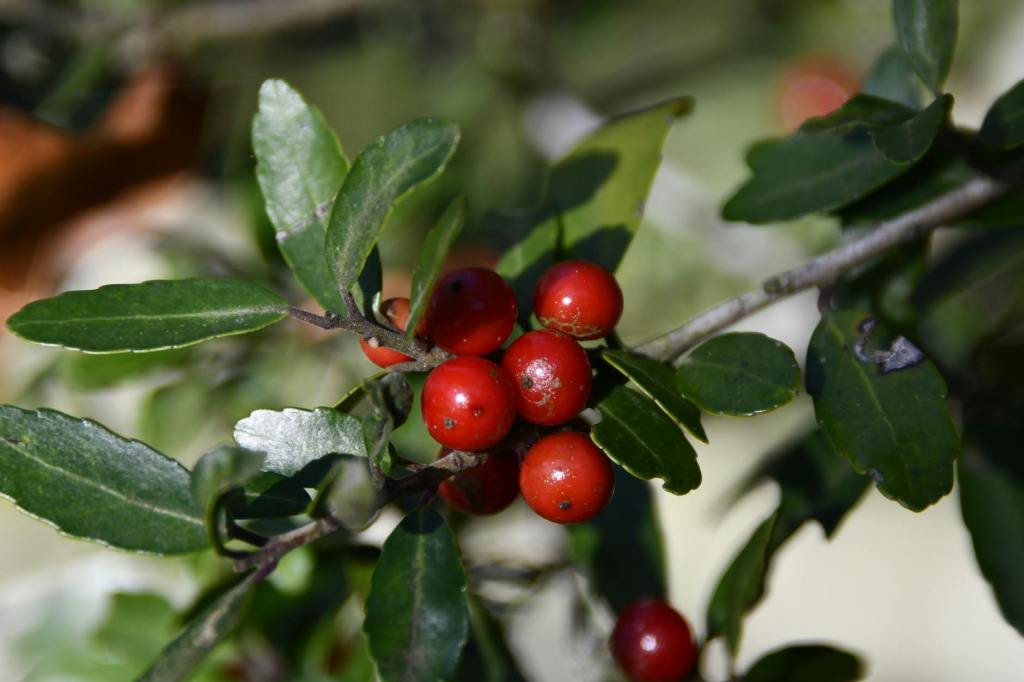
Yaupon Holly, Ilex vomitoria, has been used for centuries by Native American tribes in infusions for energy, ceremony, medicine, and purification rituals. The Cherokee called it the ‘beloved tree,’ and it was considered sacred by all.
Native to the Atlantic and Gulf Coasts, Yaupon is related to Yerba Mate and Guayusa, and is abundant here in East Texas. It is the only native plant that contains caffeine in North America.
It is easily confused with Chinese Privet, which is toxic, so listen up! The leaves are similar in size and shape, but there are differences. Yaupon has a random, chaotic leaf growth pattern while Chinese Privet leaves grow uniformly on either side of the stem, in pairs opposite each other. Yaupon also has bumpy edges, whereas Chinese Privet leaves have a smooth edge. Click here for some great side-by-side photos to help you tell the difference.
Yaupon leaves are simple, evergreen leaves with a smooth, elliptical shape that grow from 1/2 to 1 inch long, alternating along the stem with margins of rounded serrations. They are a glossy dark green on top and lighter in color on the bottom all year long.
Yaupon flowers are small and white with four clustered petals. At about 1/8 inch, they are quite inconspicuous, but beloved by bees. On female plants, the flowers form into bright red 1/4-inch-wide berries that have four seeds. They typically show up around fall and early winter and are eaten by birds.
Yaupon can grow anywhere from 15-25 feet tall and usually has dense branches with multiple gray trunks.
While the bright red berries aren’t exactly toxic, they don’t taste good and can induce vomiting.
Yaupon Contains:
- antioxidants
- chlorogenic acid
- polyphenols
- flavonoids
- theobromine (alkaloid in dark chocolate)
Yaupon Actions:
- neuro-protective
- anti-diabetic
- anti-inflammatory
- antibacterial
- heart protective
- weight management
- antioxidant
Yaupon Tea
Not only is Yaupon a great source of caffeine, but it also has many of the same compounds that traditional green tea does, including antioxidants. It has a slightly sweet flavor that makes it both healthy and delicious, whether you add anything to it or not.
To make Yaupon tea, you first need to dry the leaves by trimming off branches and leaving them in a warm, dry area for about two weeks. If you hang to dry, put something underneath to catch the leaves as they dry and fall off the branch. This natural drying process allows enzymes in the leaves to break holes into the cell wall, which in turn allows more caffeine to release into your water.
You can also fast-dry the leaves in a dehydrator or an oven set at 200 degrees Fahrenheit, but you won’t get as much caffeine per leaf as you would with air drying. However, fast-drying leaves give them a different flavor, similar to the undertones in green tea.
To get the richest flavor, roast leaves in a 400-degree Fahrenheit oven after two weeks of slow drying. This can be a finicky step and takes some practice because if the leaves get too dark, they taste burnt. Lay the leaves on a cookie sheet. They can overlap a little, but you want as close to a single layer as possible for the best outcome. To start, put the pan in the oven for four minutes for minimal roasting. The longer your roast, the more complex the flavor will be, but there is a fine line between perfection and overdone, so be careful.
Yaupon tea is a great substitution for coffee. Coffee is actually one of the most toxic things we consume, not because of what it is, but because of how it is processed. Unless you pay the money, you are drinking toxic sludge every morning to start your day. And we wonder why we feel bad. Caffeine has actually been shown to protect the brain from Alzheimer’s disease, but you need a quality product, or you can create more problems by ingesting pesticides, toxins, mold, and more!
Wildcrafting your own Yaupon lets you control what goes into your body. Avoid harvesting from busy roadsides where plants absorb heavy metals and toxins from vehicle exhausts or areas where pesticides have been sprayed. Get to know the plant and go find it in the wild!
Dried Yaupon leaves were traditionally smoked during Native American rituals, although they are typically mixed with other herbs like Lobelia, wild Tobacco, and Dogs Tongue. Go check out this site for more info on smoking Yaupon. It’s a good read and they actually offer Yaupon smokage.
I am not sponsored.
Today’s Herb of the Week was entirely free, but most herbal blog posts contain Subscriber Only content. If you want a Full Access Subscription, you can subscribe below. You also get access to the Library and it only costs $2.99 p/month!
You can find me on Facebook and Instagram for more fun stuff or check out my Etsy Shop where I sell natural remedies. Orders over $35 get free shipping, so have a look around! You might find something you like.
Subscribe to get full access.
Many blessings,
Emma Lee Joy
Today’s post is compiled from the following sources:
* Foraging Texas
* Wikipedia
* Yaupon Tea

 Red Hawk Ridge
Leave a comment