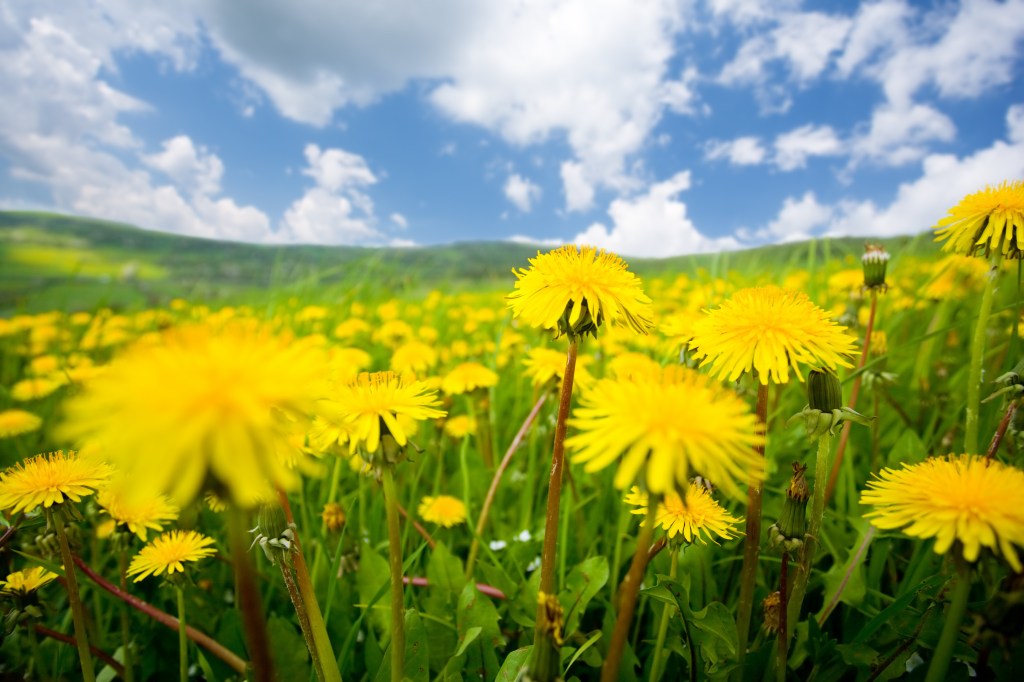
Dandelion, Taraxacum officinale, is considered a weed by most, even though the flowers are a beautiful yellow, blooming in late winter to early spring. But a weed is anything growing where you don’t want it to be. If people knew how wonderful this little lion was, they would happily let her take over their yards.
“Taraxacum officinale is actually a group of several hundred plants. These are divided into nine sections and are very difficult to distinguish…they are all safe medicinal plants.”
-‘Backyard Medicine’ by Julie Bruton-Seal & Matthew Seal, pg. 62
This lady is both edible and medicinal. I have personally picked Dandelion leaves and added them to my mustard greens, but they are a fantastic addition to a plethora of dishes. Dandelion has a peppery bite that is great fresh or cooked, although the older the leaf, the more bitter the flavor. She has a particular affinity for improving the liver, gallbladder, urinary, and digestive systems in the body, and is great for a Spring Detox.
Dandelion root goes well with Burdock root and Cleavers for a detox tonic.
Almost everyone loves the look of a freshly cut lawn, but when you let these plants grow, you will not be disappointed. When we lived in town in East Texas, we were not the greatest at keeping our lawn prim and proper (luckily, we didn’t have an HOA on our side of the highway), and I managed to grow many dandelions and wild blackberries IN TOWN when the lawn was left to its own devices without planting a thing. Condolences to those of you who live in neighborhoods that require you to keep your yard mowed and ‘presentable.’ Maybe you can bring this info to your neighborhood council and enlighten some people on the usefulness of ‘weeds.’
“Dandelion’s Medicine is perseverance. But not the perseverance of the martyr. Instead, Dandelion is the eternal optimist…”
-Maia Toll, The Illustrated Herbiary, pg. 49
However, even if you do have a well-kept lawn, you may notice that Dandelions adapt to their environment. She can learn to grow her flowers low to the ground, escaping the blades of your lawnmower, and she also grows fast, making her one of the first to appear after you mow.
“Adaptable” and “tenacious” are two great words to describe Dandelion.
Dandelion has a tendency to spring up wherever she pleases, not just the yard you want to keep mowed. Cracks in the sidewalk can grow dandelions just as well as a garden. And not only that, but she can also be found almost year-round in nearly every part of the world. She isn’t picky about the weather unless the ground is freezing for prolonged amounts of time, but even that may not kill the large taproot of established plants. Even if she disappears above ground, she will be one of the first plants to spring forth when the temperatures warm up a little.
As an extremely hardy plant, I would consider Dandelion a survivalist’s friend. She is easy to identify and has no toxic look-likes. The few plants that could be mistaken for her are also edible.
“Remember, perseverance isn’t about putting up with untenable situations; it’s about knowing the difference between that which is difficult but doable and that which is simply unhealthy for your soul.”
-Maia Toll, The Illustrated Herbiary, pg. 51
Dandelions can be made into salads (leaves and flowers), caffeine-free coffee (roasted roots), wine (flowers), beer (flowers), and tea (aerial parts) and used medicinally in a variety of ways. She is almost indestructible, perennial, and self-fertilizing. With a deep tap root, she is hard to dig out, and any pieces left will regenerate into a new plant. Seeds can soar miles in the wind, and flowers last almost all year long. Any amount of mowing, herbicide, and ‘flame throwing’ fail to kill this plant, but do not ingest plants from areas that have been sprayed with chemicals or on high-traffic roadways, as they absorb the toxins in the sprays and those released by vehicle exhausts.
“In many cultures the lion has been the animal symbol of the sun, and its astrological sign is Leo. Dandelions are yellow disks, like the sun, and open and close along with it.“
-‘Backyard Medicine’ by Julie Bruton-Seal & Matthew Seal, pg. 62
Dandelion is a perennial plant growing almost 2 feet tall, with ragged basal leaves, hollow stalks, and golden-yellow flowers. She gets her name from the saw-edged leaves or perhaps the tiny florets found in many languages.
dent de lion= ‘teeth of the lion’
The old name means ‘rays of the sun’ rather than ‘teeth of the lion’, and I am sure many of my readers can find correlations to the Sun/Son and the Lion, but I will not go into that. Have fun with research if it intrigues you. The Chinese have long used the dandelion and have named it ‘yellow-flowered earth-nail’ and ‘golden hairpin weed.’
Dandelion Contains:
- Sesquiterpene lactones
- Triterpenes
- Vitamins A, B, C, and D
- Leaf Only Contains:
- Coumarins
- Carotenoids
- Minerals (especially potassium)
- Root Only Contains:
- Taraxacoside
- Phenolic acids
- Minerals (potassium, calcium)
- Leaf Only Contains:
Key Actions Includes:
- Diuretic
- Detoxifying
- Bitter
Dandelion is high in minerals like potassium, iron, and Vitamins like A, B, C, and D. Young leaves and flowers can be made into a tea/infusion or eaten fresh in salads and the root can be boiled down and drank in a decoction, both as detoxifiers to cleanse the blood by increasing elimination through the kidneys and bowels. It is a wonderful herb for the liver, especially where there are toxins and heat in the blood.
Being a bitter herb, Dandelion is great for digestion. The bitter taste stimulates the secretion of digestive fluid, including stomach acid, bile, and pancreatic juices. Dandelion promotes appetite and is recommended for those who have been ill or have lost the enthusiasm for food in advanced age.
Roasted Dandelion root, harvested from older plants (around two years old), can be used as a caffeine-free coffee substitute. If you harvest roots in their first year, they will be too small for the work they take. Cardamom, Cinnamon, and Clove are great additions, or you could even mix it with Chicory root. The roots can also be eaten as a vegetable.
Harvesting roots of a plant typically kills the plant; however, Dandelion may respawn from bits left in the ground.
Dandelion flowers can be eaten straight off the plant, made into tea, added to salads, or even battered and fried for a tasty snack like Elder flowers. If you want to eat them as a snack, it’s better done for lunch since the flowers are more bitter when picked in the evening, and they close as the sun goes down, even when freshly picked. You’ll notice this if you try to dry them as well.
I won’t go into the method of making Dandelion Wine, but I am sure most of us read the book of the same name in school growing up. It is actually a thing. There are plenty of sources online for making Dandelion Wine, but you can find a recipe for Dandelion Beer in the subscriber section of this post.
The entire plant has diuretic properties, but the root is the most potent. It helps flush urine and excess fluid from the body, making it beneficial for urinary tract infections and fluid retention. Diuretic effects can treat swollen ankles, fluid retention, and high blood pressure. It can also help reduce high cholesterol and the pain of arteriosclerosis and joints, digestive problems, chronic illness, viral infections, and heart/lung irregularities. Most diuretic drugs cause potassium loss in the body, but Dandelion is very high in potassium and can be safely used long-term. The leaves boiled with veggie and/or bone scraps make a potassium and calcium-rich broth.
“Dandelion may well be the world’s most famous weed…Up until the 1800s [American] people would actually pull the grass out of their yards to make room for Dandelions and other useful ‘weeds’ such as Chickweed, Malva, and Chamomile.”
-Mars (1999)
Dandelion Tincture:
NOTE: The roots and leaves can be tinctured separately for specific uses but are generally tinctured together if you aren’t going to be mixing it with other tinctures for specific purposes. You can also throw the flowers in there if you aren’t using them for anything else.
- Dig up the plant (leaving a bit of root if possible), thoroughly wash/scrub the dirt off, and remove dead leaves. Chop and place in a large Mason jar. (The more surface area touching liquid, the better.)
- Cover with vodka or a similar alcohol. You can read my tincture post for an in-depth How-To and my alcohol preferences. The alcohol you choose makes a difference both in potency and taste.
- Place in a cool spot out of the sunlight for 4-6 weeks. Shake occasionally.
- Strain and squeeze through cheesecloth or a clean rag. Pour into a clean glass bottle or jar, label, and store.
NOTE: If you have dark glass jars, they are best for herbal preparations, but clear jars stored in an area out of direct sunlight is fine. Dark glass keeps light from damaging the chemical compounds in your tincture/oil. This is why essential oils and other related products come in dark bottles (or they should).
Tincture Dosage:
*Take under the tongue or diluted in water. If possible, an empty stomach is best.
- For general health maintenance, take 30-60 drops 2x’s a day.
- For acute skin eruptions, take 10 drops frequently throughout the day until the skin clears.
- For digestive problems, recuperation from chronic illness, sluggish liver, arthritis, gout, eczema, and psoriasis, take 30-90 drops 3 x’s a day.
- For overindulgence in food/drink, take 10 drops every hour until you feel better.
Subscribe to get full blog access!
If you liked this week’s Herb of the Week, like and subscribe, and I’ll see you next week. In the meantime, go check out my Etsy shop and read more about my products on in the Apothecary. You can also follow me on Facebook and Instagram.
Many blessings,
Emma Lee Joy
Information in this article was derived from personal knowledge and experience, as well as the following texts:
* ‘The Illustrated Herbiary’ by Maia Toll, pg. 48-51
* ‘Backyard Medicine’ by Julie Bruton-Seal & Matthew Seal, pg. 62-67
* ‘Medicinal Herbs: A Beginner’s Guide’ by Rosemary Gladstar, pg. 124-128
* ‘Encyclopedia of Herbal Medicine’ by Andrew Chevalier, FNIMH, pg. 141, 289
* ‘The Green Pharmacy’ by James A. Duke, Ph.D., pg. 39, 83, 92, 310, 340-341, 356, 421, 425, & 453


 Red Hawk Ridge
Leave a reply to Plantain – Red Hawk Ridge Cancel reply