
Common Plantain (aka Broad-leaf), Plantago major, is generally what you will find in herbalism books; however, there are many other varieties of Plantain, including Narrow-leaf Plantain, Ribwort Plantain, and Greater Plantain. They all work about the same.
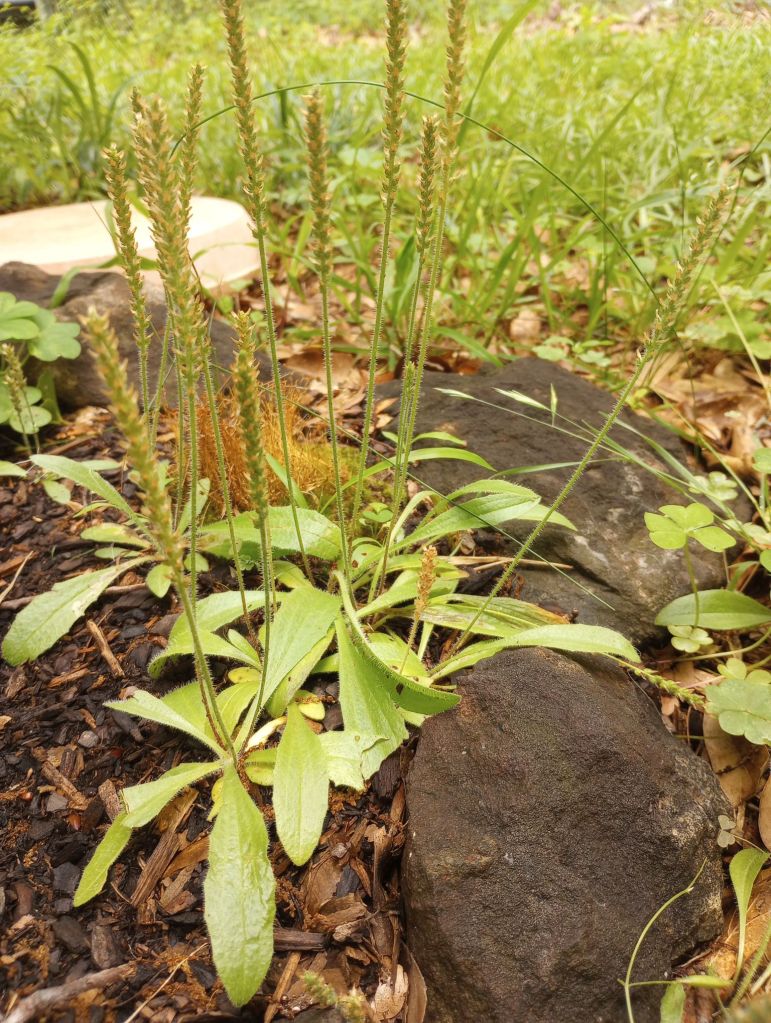
Some people say one species works better for certain things over another, but I say what works best is what you have on hand or can find. If you can’t get your hands on Ribwort Plantain but have more than you could ask for in Narrow-leaf, I don’t see why you wouldn’t use it on a bug bite just because someone has claimed Ribwort is better for field poultices. As for me, I have the smaller P. virginica variety growing abundantly in my garden beds (and everywhere else).
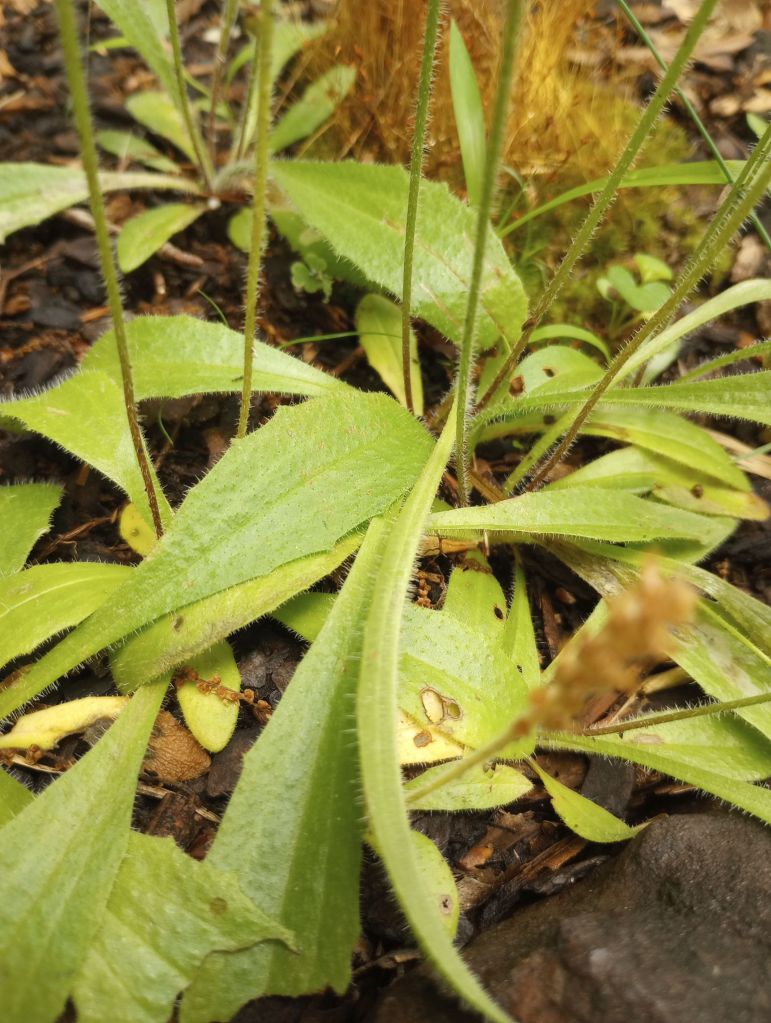
Plantain is a perennial plant that grows about ten inches tall. It has a basal rosette of broad, deeply veined leaves that can be fuzzy, depending on the variety, with dense clusters of little green flowers on stalks. The veins all start at the base of the leaf rather than branching out from a single vein down the middle. This is one of the easiest ways to determine if you have Plantain, even if it hasn’t yet developed flower stalks. Narrow-leaf Plantain has narrow leaves instead of broad leaves like Broad-leaf Plantain, and Ribwort Plantain has deeper ridges in the leaves, but the rest of the plant generally looks the same.
There are a few plants that might be confused with Plantain:
- Hosta-a genus of many plants, that have veins similar to Plantain, but much larger, heart-shaped leaves of various colors with a main middle vein. Generally safe for humans, but I don’t know enough about this plant to tell you to eat it.
- Lillies-have leaves with veins similar to Plantain but grow up the plant while Plantain stays near the ground. The flowers are also vastly different. Certain varieties are edible, others are not. Toxic to pets.
- Chicory-has similar leaves, but with bright blue flowers. The root can be used as a caffeine-free coffee substitute and the leaves are edible but bitter.
- Curly Dock-has similar leaves, but they are larger and ‘curly,’ per the name. Has some medicinal benefits but is toxic to livestock. Seeds are toxic to poultry.
- Dandelion-has toothed leaves that grow close to the ground like Plantain but with a main vein. I have an entire post on this lovely lady if you want to know more.
With a little research on each plant, you will be able to easily tell them apart. When you learn what to look for, you can be more confident in your plant identification.
Plantain is known as “nature’s Band-Aid.”
This lady is native to Europe and temperate regions of Asia. Called the “healing plant” in Gaelic, it was historically used extensively in Ireland to heal wounds and bruises. Some Native Americans call it “Englishman’s foot” because it seemed to spring up in the footsteps of white settlers and is associated with colonialism in many areas of the world. It is rarely cultivated as it grows abundantly in the wild and in any cracks and crevices it can take root in, although Buckshorn Plantain (P. coronopus) is grown in Italy as a salad crop. The leaves are mainly what you want for medicine and are harvested during the summer season, but the seeds also have their uses and are harvested from mature flower stalks (explained later).
You can eat young Plantain leaves like spinach.
Plantain Contains:
- iridoids (like aucubin, which increases uric acid excretion by the kidneys)
- flavonoids (like apigenin, an anti-inflammatory)
- tannins
- plant acids
- mucilage
- allantoin (also found in comfrey)
- iron
- calcium
- vitamins A, B, C, and K
Key Actions:
- diuretic
- expectorant
- decongestant
Uses:
- gastritis
- peptic ulcers
- diarrhea
- dysentery
- irritable bowel syndrome
- respiratory congestion
- loss of voice
- urinary tract bleeding
- dandruff
- hemorrhoids
- heavy menstruation
Plantain has a reputation for drawing out poison from bites and infections and can easily be chewed up and applied as a quick poultice in the field. Although all species make field poultices, it is said that Ribwort is the best for it but use what you got. You can also use it to aid in the removal of stubborn splinters. It can relieve irritation and pain caused by the sting of Nettle and Poison Ivy, and its antihistamine effect works for hay fever and other allergies.
Plantain combines well with Elderflower and Mint in an infusion for many seasonal ailments.
Shakespeare even mentions Plantain twice as a healer of broken skin. It may not be as effective on bones as comfrey, even though it can be used for bruises and broken bones in the event that you don’t have comfrey, but it is great at clearing heat and inflammation. Plantain also staunches blood flow (like Yarrow and Goldenrod) and encourages the repair of damaged tissue (which means it speeds up the healing of wounds).
“Plantain closes the gaping wound with a seam of gold thread; for, just as gold will not admit of rust, so the plantain will not admit of rotting and gangrenous flesh.”
-Abbe Kneipp, 1821-97
The same qualities that make Plantain useful for wounds also make it helpful when dealing with teeth and gum infections. Place a wad of crushed Plantain against the affected area. Back that up with a Plantain infusion mouthwash.
If anyone has ever played Far Cry Primal, I am almost positive the green leaf you collect to tend to the woman’s wounds at the beginning of the game is an ancient variety of Plantain. I could be wrong, but the way they use the green leaf is the same way you would use Plantain in a situation like that.
“It is the best herb for blood poisoning, reducing the swelling and completely healing a limb where poisoning has made amputation imminent.”
–Dr. Christopher, 1976
Harvesting Plantain
Leaves can be picked and used as needed, remaining green for most of the year, but peak time is during the summer. You can freeze the leaves if you live in an area with harsh winters or gather and dry them by spreading them on a drying screen or hanging them in a well-ventilated area. Discard any that turn black.
Harvest seeds when ripe, picking the flower heads and spreading them to dry before shaking the seeds out into a paper bag or similar. Be gentle, or you will knock the seeds off and have to chase them around on the floor.
Crushed Leaf Poultice
This can be as simple as chewing up leaves and applying them directly to the skin in the field, or you can crush them with a mortar and pestle or puree in a blender. Crushed leaves are used for insect bites/stings, allergic rashes, cuts and wounds, infected cuts, bleeding, mouth ulcers, boils and ulcers, burns, acne rosacea, hemorrhoids, and shingles.
Plantain can soothe the itch from Poison Ivy and Stinging Nettles!
Plantain Infusion
Use a heaping tablespoon of crumbled dry or fresh leaf per mugful of almost boiling water. Steep until cool and strain.
- Drink one mug up to 3x’s a day to treat sore throat, laryngitis, cough, bronchitis, and heavy menstrual bleeding.
- Use as a hair wash to treat dandruff.
- Use in a compress for burns (however, a poultice works best for this).
Plantain Tincture
Pick fresh Plantain leaves or use dried plant matter and 100-proof alcohol. Vodka is my favorite. You can find more information on different alcohol and tips to get the full run down of how to make a tincture here. They are easy to make and last for ages. If using Everclear, use equal parts alcohol and distilled water. (Explained more in the tincture post.)
Dose: 1/2 to 1 teaspoon 3x’s a day for coughs, mild bronchitis, irritable bowel, heavy menstrual bleeding, hemorrhoids, and hay fever.
Plantain Salve
You can use Plantain-infused oil to make a skin-healing salve. If you want to get fancy, Essential Oils are always a good addition, and you can also infuse herbs like Yarrow, Red Clover, Burdock leaf, Self-Heal, Prunella vulgaris, any type of Mint you have, and more! Just decide what properties you want it to have and go for it!
A Plantain-based salve is good for nearly any kind of skin infection or irritation.
TO USE: Apply directly to the affected area multiple times a day until the problem subsides.
Plantain Seed
Plantago psyllium is a cultivated variety that has large abundant seeds used in products like Metamucil. In an Italian study, the seeds were shown to help with weight loss (Plantain infusion can as well.)
Seeks and husks can be ground in a coffee grinder before eating or used whole.
Dose: Sprinkle 1 teaspoon on food or take in capsule form 1-3x’s a day for constipation, irritable bowel syndrome, and as a weight loss supplement.
NOTE: Eating the seeds will work like Metamucil does, so be warned.
In today’s day and age, where the world is going crazy, know that you don’t have to rely on man’s institutions to stay healthy. It just takes a little knowledge and know-how. I’m not saying to avoid hospitals when things are dire, but an everyday health-minded routine can be very beneficial. God gave us these plants for a reason, and this one in particular is extremely abundant!
Today’s Herb of the Week was entirely free, but most herbal blog posts contain Subscriber Only content. If you want a Full Access Subscription, you can subscribe below. You also get access to the Library and it only costs $2.99 p/month!
You can find me on Facebook and Instagram for more fun stuff or check out my Etsy Shop where I sell natural remedies. Orders over $35 get free shipping, so have a look around! You might find something you like.
Subscribe to get full access.
Many blessings,
Emma Lee Joy
Today’s post came from personal knowledge and experience, and from the following texts:
* ‘The Green Pharmacy’ by James A. Duke, Ph. D., pg. 105-106, 155, 250, 294, 307, 359, 407, 417, & 343-344
* ‘Encyclopedia of Herbal Medicine’ by Andrew Chevallier, FNIMH, pg. 250-251
* ‘Medicinal Herbs: A Beginner’s Guide’ by Rosemary Gladstar, pg. 188-191
* ‘Backyard Medicine’ by Julie Bruton-Seal & Matthew Seal, pg. 143-146

 Red Hawk Ridge
Leave a comment